
“So… this is basically grape juice, right?”
It’s the question almost everyone asks the first time they come across a 0% wine — sometimes out loud, sometimes silently while scanning the label. And to be fair, the confusion is understandable. No alcohol, made from grapes… it sounds like an easy shortcut to a conclusion.
But that assumption is exactly what’s holding many people back from discovering one of the most interesting shifts happening in the way we drink today.
Because NoLo wine isn’t trying to replace wine with something simpler.
It’s trying to preserve everything people love about wine — the freshness, the structure, the way it works with food and elevates a moment — just without the alcohol.
At a glance, the confusion makes sense. Both come from grapes, both contain no alcohol, and both can be refreshing. But in reality, they belong to two completely different worlds.
Grape juice is simply pressed fruit. It hasn’t gone through fermentation, which means it keeps all its natural sugars and remains straightforward, sweet, and one-dimensional. It’s enjoyable, but it doesn’t behave like wine — it doesn’t pair particularly well with food, and it lacks the balance and tension that make wine interesting.
NoLo wine, on the other hand, starts its life exactly like traditional wine. The grapes are fermented, structure develops, aromas evolve — and only then is the alcohol gently removed. What you’re left with is not juice, but something much closer to the essence of wine: freshness, acidity, and a sense of balance that allows it to sit naturally at the table.
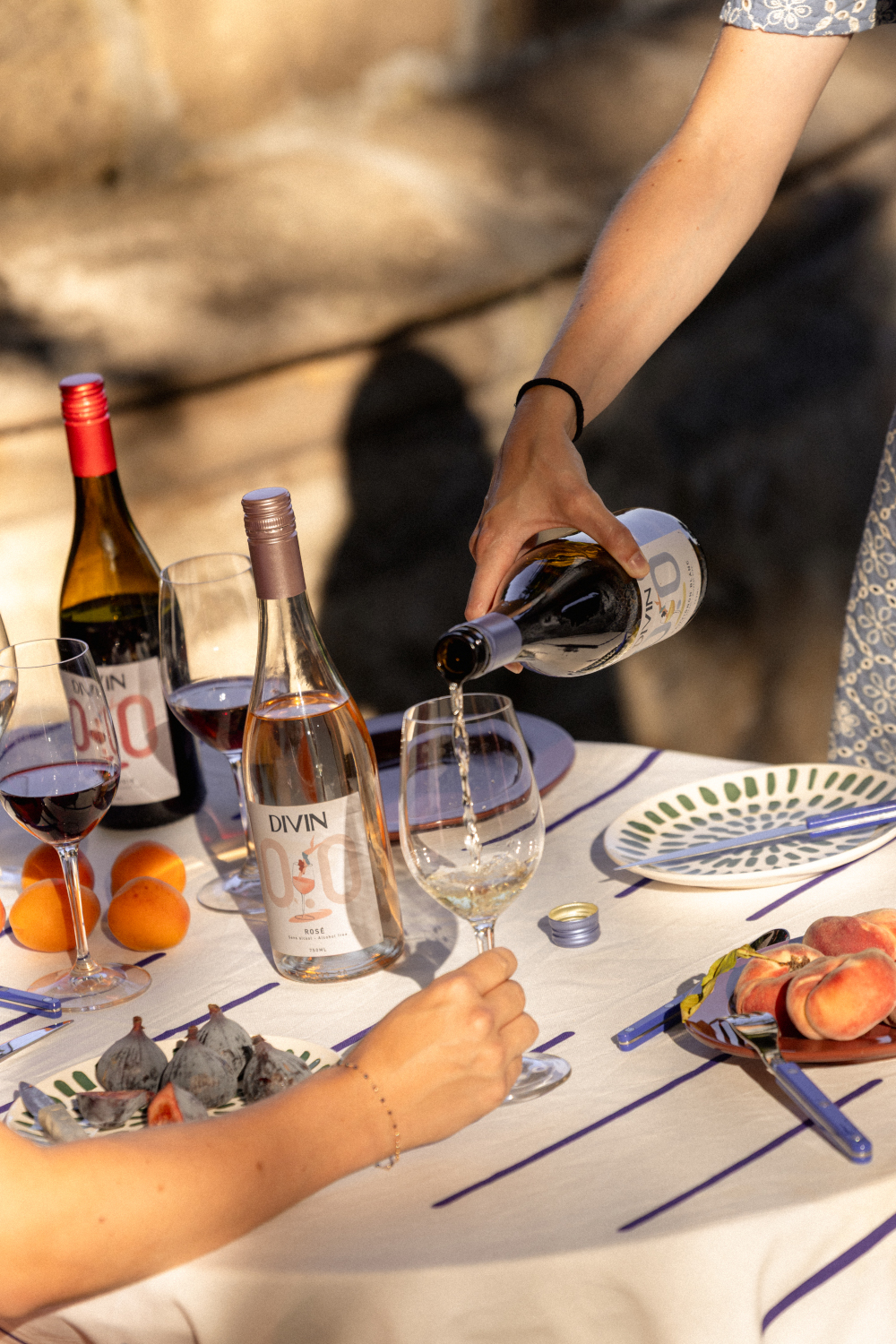
A good way to understand this is to taste a well-made example like Divin 0.0 Sauvignon Blanc. Instead of sweetness, you’ll find a clean, zesty profile — lemon, green apple, a touch of minerality — the kind of crispness you would expect from a classic Sauvignon Blanc. It’s light, refreshing, and, most importantly, it works with food. Try it with a goat cheese salad or grilled fish, and it behaves exactly as a wine should: it lifts the dish rather than overwhelming it.
That’s the key difference. Grape juice refreshes; NoLo wine interacts. It plays a role in the meal, in the moment, in the ritual of drinking — which is ultimately what people are looking for when they reach for a glass.
Of course, not all NoLo wines are created equal, and early versions of the category didn’t always help their case. Some were indeed closer to juice than wine. But modern techniques have changed that significantly, allowing producers to retain much more of the character and structure of the original wine.
So the real question isn’t whether NoLo wine is grape juice — it isn’t.
It’s whether you’re open to experiencing wine in a different way.
Because once you shift that perspective, something interesting happens: you realise there are moments where you don’t necessarily want alcohol — but you still want the pleasure of a proper glass of wine.
And that’s exactly where a wine like Divin 0.0 Sauvignon Blanc comes into its own. Crisp, refreshing, and genuinely wine-like, it offers a simple proposition: all the enjoyment, none of the compromise.